Your website feels outdated. Maybe the design no longer represents your brand. Maybe competitors suddenly look more polished. Maybe the site feels slow, awkward on mobile, or simply does not generate the enquiries it used to.
Naturally, the first thought is often, “We need a new website.”
But do you?
Sometimes, your website genuinely needs to be rebuilt. Other times, tearing everything down would be expensive, unnecessary, and possibly even harmful. What you actually need might be a refresh.
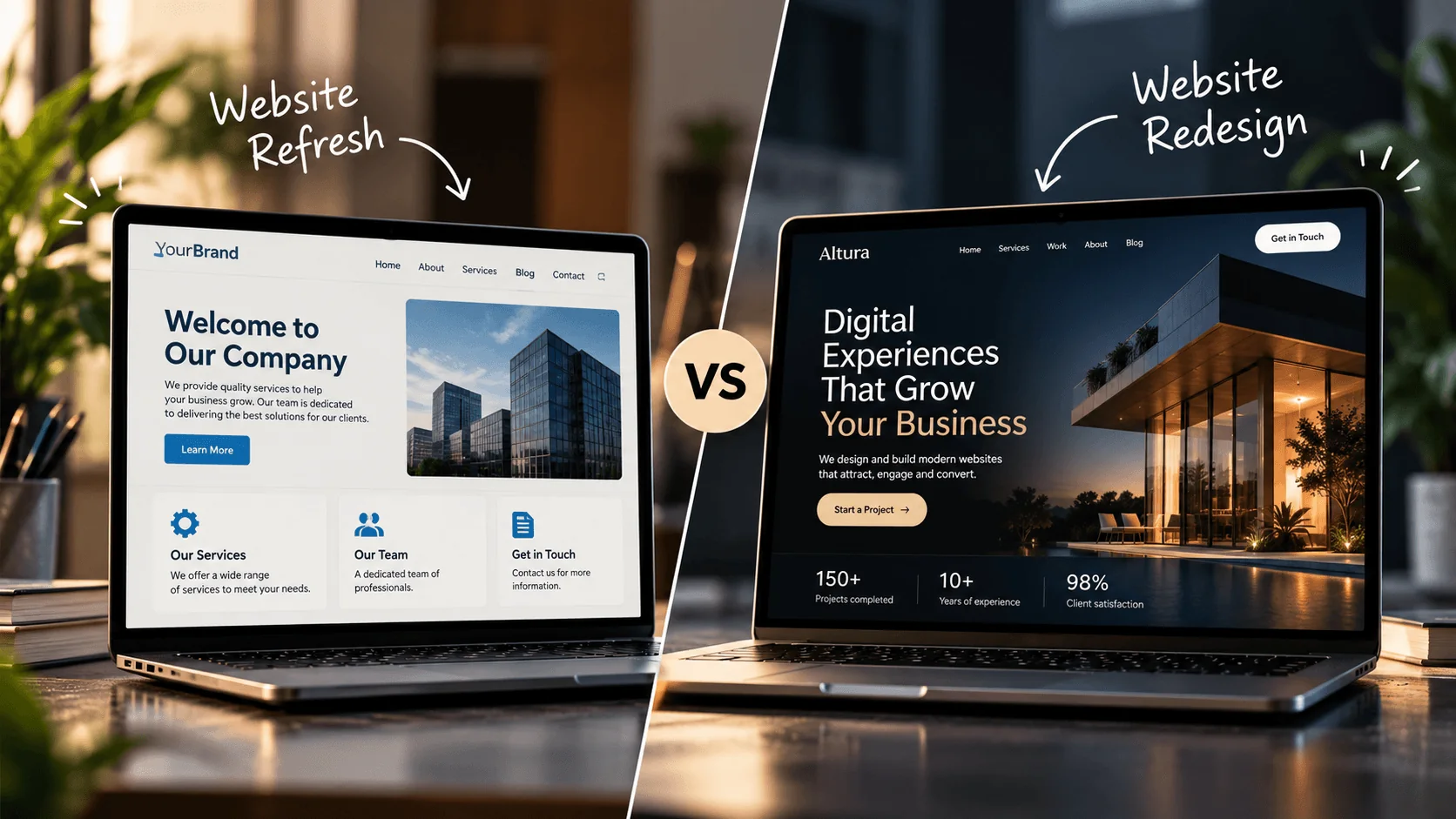
The problem is that a website refresh and a website redesign are often treated as though they mean the same thing. They do not. Knowing the difference can save your business a surprising amount of time, money, and frustration.
What is a website refresh?
Think of a website refresh as renovating a house that still has good bones. The structure works. The rooms are where they should be. The foundation is solid. The problem is that the paint looks tired, the furniture feels dated, and a few things could be arranged better.
You are improving the experience without rebuilding the house.
A website refresh works the same way. You keep most of the existing structure, technology, and content, but improve the parts that make the website feel dated or ineffective.
That could mean updating the typography, changing the colors, improving the layout, replacing old images, rewriting important sections, simplifying the navigation, or making calls to action clearer. You might also improve the mobile experience, speed, accessibility, or certain conversion points.
The website remains fundamentally the same website. It simply becomes a much better version of itself.
So what is a website redesign?
A redesign goes much deeper.
Instead of asking how the website can look better, you begin asking whether the website itself still makes sense.
Does the page structure still work? Does the navigation reflect how customers actually use the site? Is the technology still suitable? Does the content support the business today? Would you build the website the same way if you were starting from scratch?
A proper redesign can involve changing the entire visual direction, page structure, user journey, content strategy, navigation, technology, and sometimes even the platform the website runs on.
It usually becomes necessary when the problem is no longer cosmetic. The website itself has stopped supporting the business.
That is the simplest distinction.
A refresh improves what already works. A redesign rethinks what no longer does.
When a website refresh is probably enough
Not every old website needs to be destroyed.
If your website still has a strong structure and visitors can easily find what they need, you may only need targeted improvements.
Perhaps your branding recently changed and the website has not caught up yet. Maybe the typography feels dated, the photography no longer reflects the quality of your business, or some pages contain old information. Maybe the calls to action need improvement, or the mobile experience needs refinement.
These are real problems, but they do not necessarily justify rebuilding the entire website.
If your site already ranks well on Google, loads reasonably quickly, has a logical structure, and continues to generate business, changing everything simply because the design feels old can introduce more risk than value.
Sometimes, the smartest decision is to leave the foundation alone and improve the parts people actually see and use.
When a redesign becomes necessary
Now imagine something very different.
Your business has changed significantly since the website was built. You offer different services. You target a different type of customer. Your brand has evolved. The website contains pages nobody needs anymore, visitors struggle to navigate it, and your team finds it difficult to update.
You make small improvements, but the website still feels fundamentally wrong.
That is no longer a surface problem.
At that point, refreshing the website can become the digital equivalent of putting expensive wallpaper over a cracked wall. It may look better temporarily, but the underlying problem is still there.
A redesign becomes necessary when the structure, strategy, or technology of the website is holding the business back.
Your business may have outgrown the website
This is one of the clearest signs that a redesign might be necessary.
Websites are usually built around the business that exists at the time. But businesses change.
Maybe you started with one service and now offer five. Maybe you were targeting small businesses and now work with larger companies. Maybe you operated locally and now serve customers across several markets.
Perhaps the website was created when you were trying to establish credibility, but today you have case studies, client results, stronger positioning, and a much more developed brand story.
Your website should evolve with the business.
If your current website is forcing a much bigger company into a structure that was built for a much smaller one, a few cosmetic changes will not solve the problem.
The website needs to be reconsidered around where the business is now and where it is going next.
Look beyond the homepage
One common mistake businesses make is deciding whether they need a redesign based entirely on the homepage.
The homepage looks old, so they assume the entire website needs to go. Or the homepage looks beautiful, so everyone assumes the website is fine.
Neither conclusion tells you enough.
You need to look deeper.
Open your service pages. Check the mobile version. Try filling out your own contact form. Navigate the website as though you had never seen it before. Try to find important information. Look at your analytics and see where people leave.
Which pages generate enquiries? Which pages barely get visited? How quickly does the website load? Can users find what they need without thinking too much?
A website is a system. You cannot properly diagnose it by staring at the hero section.
Sometimes the design is not actually the problem
This is where businesses can spend a lot of money unnecessarily.
Your website may look dated, but that might not be the reason it is underperforming.
Perhaps the real problem is poor traffic. Maybe your offer is unclear. Maybe your marketing is attracting the wrong audience. Maybe your pricing does not fit the market. Maybe visitors cannot understand the value of your service.
A new website cannot magically fix every business problem.
That is why a redesign should begin with diagnosis, not design inspiration.
Before asking, “What should the new website look like?” ask a more useful question:
What exactly is the current website failing to do?
That question can completely change the direction of the project.
Do not redesign simply because you are bored
You see your website all the time.
Your customers do not.
That difference matters.
After looking at the same design for two or three years, you may naturally become tired of it. Then you visit a competitor and see bigger typography, new animations, or a more modern layout, and suddenly your own website feels old.
But familiarity is not the same thing as poor performance.
If customers understand the site, trust the business, and continue converting, changing everything because the internal team is bored could mean solving a problem that does not really exist.
Of course, design eventually becomes dated. But major website decisions should be based on evidence, not design fatigue.
A redesign can create problems too
Starting again sounds exciting. It can also be risky if handled carelessly.
A redesign might remove pages that currently rank well in search. Important URLs could change without proper redirects. Valuable content could disappear. Conversion paths that were working might accidentally become worse.
The new website could even become heavier and slower than the old one.
Customers who were familiar with the previous navigation might struggle with the new structure.
None of this means you should avoid redesigning. It simply means a redesign should be treated as a business project, not just a creative exercise.
The goal is not to create something different.
The goal is to create something better.
There is also a third option
The decision does not always have to be between refreshing everything and redesigning everything.
Sometimes the smartest approach sits somewhere in the middle.
You could redesign the homepage and major service pages while keeping supporting pages intact. You could improve the navigation without rebuilding the entire site. You could introduce a new design system gradually or rebuild only the parts responsible for conversion.
In other words, you can be surgical.
This approach can be especially useful when a website already has valuable content, search visibility, or functionality that you do not want to disturb unnecessarily.
Good website strategy is not about changing as much as possible.
It is about changing what matters.
So which one does your business actually need?
If your website still works structurally but simply feels dated, inconsistent, or slightly difficult to use, a refresh may be enough.
If the website no longer reflects your business, customers struggle to use it, the structure is holding you back, or the technology can no longer support where the company is going, then you may be looking at a redesign.
The distinction matters because the objective is not to have the newest website.
It is to have the right website.
A website that accurately represents the business. A website customers can understand. A website your marketing can actually use. A website that can grow with you.
Most importantly, a website that performs.
Before you tear everything down, find out what is actually broken.
You might need a new website.
Or you might discover that the one you already have simply needs to start working harder.