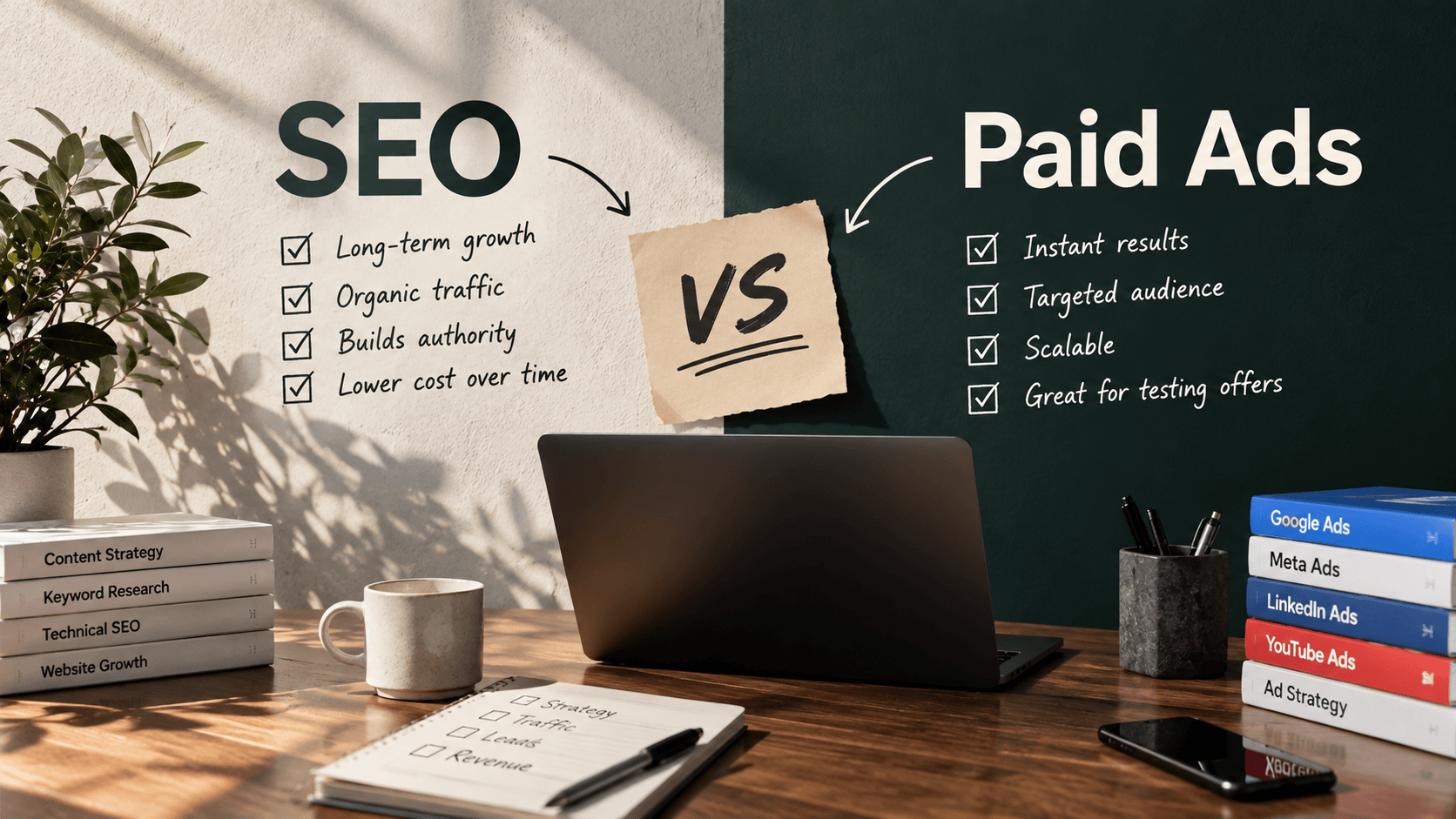
You have a limited marketing budget.
You want more traffic, more leads, and more customers. Then someone tells you to invest in SEO. Another person tells you to run paid ads. Both sound convincing.
So which one should come first?
The short answer is that both can grow a business, but they work very differently.
SEO is usually slower, but it can compound over time. Paid ads can produce results much faster, but the traffic usually slows down when the spending stops.
The better question is not, “Which one is better?”
The better question is:
Which one makes the most sense for where your business is right now?
That is what we need to figure out.
First, what does SEO actually do?
SEO is about helping your business appear when people search for the products, services, or information you offer.
If someone searches Google for something related to your business and your website appears near the top of the results, that visibility can bring people to your website without you paying for every click.
That sounds simple, but good SEO involves several things working together.
Your website needs to be technically healthy. Your pages need to answer real search intent. Your content needs to be useful. Your site structure needs to make sense. Your brand needs authority. Your pages need to load properly and work well on mobile.
SEO is not just about adding keywords to a page.
It is about becoming one of the most useful and trustworthy answers available for a particular search.
And when it works, it can become one of the strongest acquisition channels a business has.
So what do paid ads do?
Paid ads work differently.
Instead of waiting to earn visibility over time, you pay to appear in front of people now.
That might be through Google Ads, Meta Ads, LinkedIn Ads, YouTube, TikTok, or another advertising platform.
If the targeting, offer, creative, landing page, and campaign setup are strong, paid ads can start bringing traffic almost immediately.
That speed is the biggest advantage.
You do not have to wait months for a page to rank.
You can launch a campaign today and start learning how people respond to your offer almost immediately.
That makes paid ads especially useful when speed matters.
SEO builds an asset
One of the biggest advantages of SEO is that the work can continue producing value long after it is done.
Imagine you publish a strong service page that begins ranking for an important search term.
That page might bring visitors next week, next month, and potentially for years.
You may improve it from time to time, but you are not paying every single time someone visits it.
The same can happen with useful articles, location pages, comparison pages, guides, and other search driven content.
Over time, these pages begin to form an organic traffic system.
This is why SEO can become extremely valuable for growing businesses.
You are not only buying attention.
You are building something that can keep attracting attention.
Paid ads buy speed
Now imagine your business needs leads this month.
You have just launched a new service. You need customers. You cannot simply publish a few articles and hope Google sends enough traffic quickly enough.
This is where paid advertising becomes powerful.
You can put your offer in front of thousands of relevant people without waiting for organic visibility to develop.
You can test different headlines. You can test different audiences. You can test different offers. You can see which landing pages perform better.
Paid ads give you data quickly.
And for a growing business, fast feedback can be incredibly valuable.
Sometimes, knowing what does not work within two weeks is better than spending six months assuming something will work.
But paid ads come with one uncomfortable truth
The traffic is rented.
Stop paying and, in most cases, the traffic stops too.
If you spend money on ads every month and never build any other acquisition channel, your business can become dependent on advertising.
That does not automatically make paid advertising bad.
Many extremely successful businesses spend heavily on ads because the economics make sense.
If spending one dollar consistently produces three dollars in profitable revenue, stopping the ads just because they cost money would make little sense.
The issue is dependence.
A healthy business usually does not want its entire customer acquisition system controlled by one advertising account, one platform, or one rising cost per click.
That is where SEO can create balance.
SEO has its own uncomfortable truth
SEO takes time.
There is no honest way around that.
You can improve a website today and see some changes quickly, but meaningful organic growth usually requires patience.
Search engines need to discover your pages, understand them, compare them with competing pages, and gain enough confidence to rank them.
If you operate in a competitive market, you may also be competing against companies that have been publishing content and building authority for years.
That means SEO is rarely the best answer when someone says:
“We desperately need customers next week.”
You might eventually get excellent results from SEO.
But eventually does not solve next week’s cash flow problem.
Start with paid ads when speed matters most
There are situations where paid advertising should probably receive more attention first.
If your business is new and needs to validate an offer, ads can help you see whether people actually respond to it.
If you are launching a new product or service, ads can generate awareness quickly.
If you have a proven sales process and know how much a customer is worth, paid acquisition can help you scale faster.
And if your business needs leads now rather than six months from now, paid advertising is often the more practical starting point.
But there is one condition.
Your website and offer need to be ready.
Sending paid traffic to a confusing website does not solve the problem. It simply helps more people discover the confusion faster.
Start with SEO when you can afford to play the longer game
SEO becomes especially attractive when your business already has some stability and you want to reduce your dependence on paid traffic over time.
It can be particularly effective when potential customers actively search for what you sell.
Think about services like accounting, legal services, web design, healthcare, real estate, home services, consulting, software, and many other categories.
People already go to search engines looking for solutions.
If your business can consistently appear when those searches happen, you can build a powerful stream of high intent traffic.
SEO also makes sense when your business has valuable expertise that can be turned into useful content.
Every strong page you publish becomes another opportunity to be discovered.
Over time, those opportunities add up.
What if your budget is small?
This is where the decision becomes more interesting.
A small business with a limited marketing budget often feels pressure to spread that money across everything.
A little SEO.
A little Google Ads.
A little Meta Ads.
A little social media.
A little email marketing.
The result is often that nothing receives enough attention to work properly.
Sometimes, focusing is smarter.
If you need immediate leads and have a strong offer, you might put most of your initial budget into one well managed advertising channel while laying the basic foundations for SEO.
If you already have a steady flow of customers and can afford to wait for organic growth, you might invest more aggressively in SEO and content.
The right decision depends on your current bottleneck.
Do you need traffic now?
Or do you need to build a more sustainable acquisition system?
Those are different problems.
Your type of business matters too
Not every marketing channel works equally well for every business.
Suppose you sell an emergency plumbing service.
Someone with water flooding their kitchen is probably going to search for a plumber immediately. Search visibility, whether organic or paid, becomes extremely valuable.
Now imagine you sell an innovative product people do not yet know exists.
They may never search for it because they do not know what to search for.
In that case, paid social advertising may be more effective because you can introduce the product to people rather than waiting for them to look for it.
Your customer’s behavior should influence your strategy.
Do they search when they have the problem?
Do they discover products through social media?
Do they need education before they are ready to buy?
Where does the buying journey actually begin?
Marketing becomes much easier when you stop choosing channels based on popularity and start choosing them based on customer behavior.
The website sits in the middle of both
There is one thing SEO and paid advertising have in common.
Eventually, people arrive somewhere.
Usually, that somewhere is your website.
And this is where businesses sometimes waste both SEO traffic and advertising spend.
You can rank first on Google and still lose the customer if your website does not build trust.
You can run a brilliant ad and still waste the click if the landing page is confusing.
You can attract thousands of visitors and still generate almost nothing if there is no clear offer, no compelling reason to choose you, and no obvious next step.
Traffic is only the beginning.
The website has to convert that attention into action.
That is why SEO, advertising, and web design should not operate like completely separate activities.
They are parts of the same growth system.
The strongest strategy is usually not SEO or paid ads
For many growing businesses, the best long term answer is eventually both.
Paid ads can create speed while SEO builds momentum.
You can use advertising to test messaging and offers quickly. The lessons from those campaigns can improve your website and organic content.
At the same time, SEO can gradually build a channel that reduces how dependent you are on paid traffic.
One gives you immediacy.
The other gives you compounding value.
Together, they can be much stronger than either one operating alone.
But that does not mean you need to invest equally in both from day one.
Your business might begin with 80 percent of its effort in paid acquisition and 20 percent in building an SEO foundation.
Another business might do the opposite.
The allocation should follow the business need.
So where should you invest first?
Start by looking at your situation, not the marketing channel.
If you need customers quickly, already have a strong offer, and have a website that can convert traffic, paid ads may deserve priority.
If you already have some stability, people actively search for your services, and you want to build a sustainable source of traffic over time, SEO may deserve more investment.
If you have enough resources, you can begin building both at the same time, but give each one a clear purpose.
Do not run ads simply because everyone else is running ads.
Do not invest in SEO simply because someone told you organic traffic is free.
Neither channel is automatically the right answer.
The right channel is the one that matches your customer, your economics, your timeline, and the stage of your business.
Because the real goal is not to win the SEO versus paid ads debate.
The goal is to build a customer acquisition system that can actually grow your business.
And sometimes, the smartest answer is not choosing one forever.
It is knowing which one your business needs first.