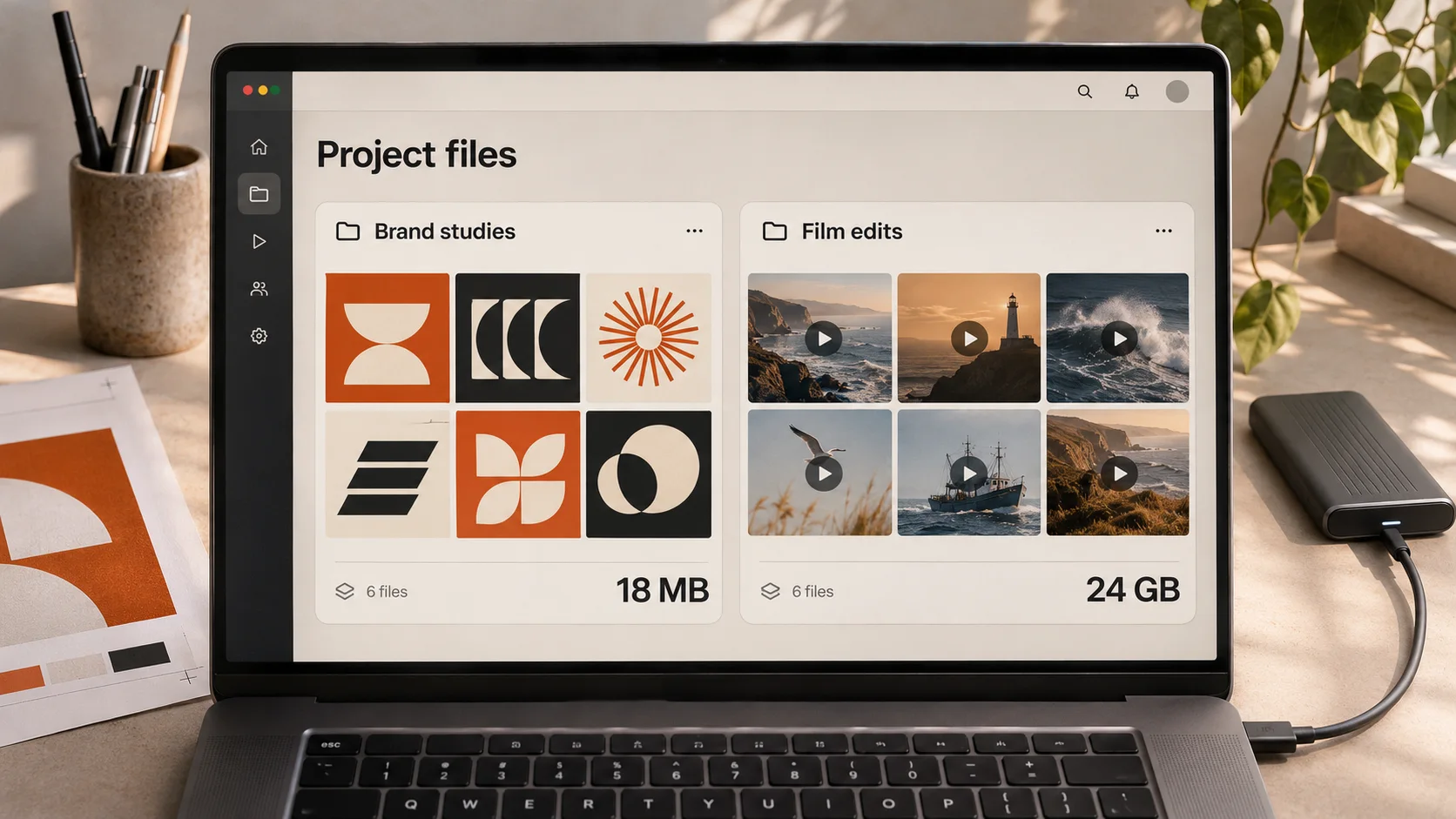
Suppose you’re building software for small design studios. Clients can sign in, review work and leave feedback. Your first paying customer is a brand designer who uploads six logo concepts. Your second is a film studio that uploads six rough cuts.
On your sales dashboard, those customers look identical. Two studios, one subscription each, six uploads apiece. On your infrastructure bill, they can look very different. One client opens a few small images. The other plays a twenty-minute film, shares it with four colleagues and asks everyone to review the next cut on Friday.
Now suppose both studios pay the same subscription fee. Do you know what it costs you to serve each one?
That question matters whether you’re planning a mobile app, a subscription product or an internal tool for your own team. And you can start answering it before a developer writes the first line of code.
Start with the month when almost nobody uses it
Imagine your first customer signs up in March and barely touches the app in April. When they return in May, they still expect their account to work, their files to be there and their comments to appear beside the right version.
Keeping that promise has a cost. Depending on how your app is built, you may be paying for the systems that run it, the database that holds customer records, file storage, backups and monitoring. Several of those may come on one invoice. Some may fall within a provider’s free allowance at first. Your developer should be able to tell you which applies to your build and what would cause the bill to change.
Ask for one figure early: “Once the app is live, what will we owe in a quiet month?” Have annual renewals listed alongside it with their payment dates. If you collect subscriptions in naira and a supplier bills you in dollars, keep both currencies visible. Six months from now, you’ll want to know whether a higher bill came from heavier use or a change in the exchange rate.
Find the activity that makes your bill grow
“Ten thousand users” sounds like a useful basis for an estimate. It tells you surprisingly little on its own. Ten thousand people checking a balance once a week create a different workload from ten thousand people watching lessons every evening.
The useful unit depends on the product.
| If you’re building… | Ask the developer to estimate… |
|---|---|
| Subscription software for teams | The cost of an active company account, including its staff, stored files and regular background tasks. |
| A learning or media app | The cost of delivering an hour of content, alongside the cost of storing the library. A popular lesson is stored once but may be streamed thousands of times. |
| An AI-powered tool | The cost of a completed task. Include cases where a customer retries, uploads a long document or asks for several revisions. |
| A marketplace | The cost of completing an order, including payment processing, customer messages and the staff time needed when an order goes wrong. |
| An internal business app | The monthly cost per team or location, compared with the hours of manual work the software is meant to save. |
For the design-studio software, I’d ask for two estimates side by side: a studio reviewing images and a studio reviewing video. That comparison can change the product before launch. You might decide that each plan includes a storage allowance, that old projects can be archived, or that video belongs on a higher-priced plan. Those are easier decisions to make before you sell “unlimited uploads” to your first twenty customers.
Two apps can look alike and cost very different amounts to operate
Consider a founder who says, “I want to build something like Binance.” Put two proposed versions on the table.
In the first, customers follow markets, save a watchlist and receive price alerts. To estimate the running cost, you’d want to know where the prices come from, how frequently they refresh, what the data provider charges for that use and how many alerts the app sends. A customer following five assets with one daily summary makes a different demand on the service from someone expecting immediate alerts across a hundred assets.
In the second version, customers can deposit assets, trade and withdraw. All the screens from the first version might still be there. But now, when a customer asks, “Where is my withdrawal?”, someone needs to trace what happened and give an accurate answer. The operating budget has to account for how transactions are processed, how balances are checked against what actually moved, how funds are safeguarded and who handles exceptions. The responsibilities you take on directly, the partners you use and the markets you operate in all affect the estimate.
A quote for hosting and price data might be a reasonable starting point for the first conversation. It would leave major questions unanswered in the second. The word “app” describes what the customer opens. It doesn’t tell you what the business has agreed to look after.
Put some numbers against the business model
Take a small subscription product charging ₦10,000 per company per month. For illustration, assume its baseline infrastructure and agreed technical maintenance cost ₦200,000 a month, and serving each active company adds an average of ₦2,000 in usage costs. These are example figures for the calculation. An actual estimate needs the product specification and supplier prices.
| Monthly calculation | 20 paying companies | 50 paying companies |
|---|---|---|
| Subscription revenue | ₦200,000 | ₦500,000 |
| Baseline infrastructure and maintenance | ₦200,000 | ₦200,000 |
| Usage costs at ₦2,000 per company | ₦40,000 | ₦100,000 |
| Amount left after these costs | −₦40,000 | ₦200,000 |
Each subscription contributes ₦8,000 towards the ₦200,000 baseline after its assumed usage cost. At 25 paying companies, the product covers the two cost lines in this example. That is a useful milestone, although the business still has to account for items such as payment fees, customer support, salaries and tax before it can call the remainder profit.
Now go back to the film studio. If that one account costs ₦12,000 a month to serve on a ₦10,000 plan, adding more customers like it makes the problem larger. An average across all accounts can hide that for months. When reviewing the first few bills, look at a typical customer and your heaviest user.
Find out what the maintenance fee buys
“The app comes with maintenance” sounds reassuring. Ask what happens on an ordinary Tuesday when a client opens a project for a presentation and the latest version has disappeared.
Who receives the alert? Can someone recover that particular project? When was that recovery process last tested? If the client reports it at 5 p.m., when should they expect a response? The answers tell you what the maintenance arrangement is worth to your business.
It also helps to agree where maintenance ends and new development begins. Restoring access to an existing project is one kind of work. Adding frame-by-frame comments to video is another. Give improvements their own budget so you can see what it costs to run today’s product and what you’re choosing to invest in tomorrow’s.
What to ask for before you sign the build quote
Ask your developer to walk you through three months on paper: a quiet month, the month you expect after launch, and a busy month in which one customer uses the product heavily. For each, ask for the total, what drives it, what support is included and which bills you’ll pay directly. A range is useful when the assumptions behind it are clear.
Then ask one final question: “What could a single customer do, entirely within the rules of our product, that would give us a surprisingly large bill?”
For one founder, the answer is uploading a year’s worth of video. For another, it’s running an AI task across every document in a company account. Knowing the answer lets you put a sensible allowance in the plan, an alert on the bill or a price on the feature while you still have the freedom to choose.