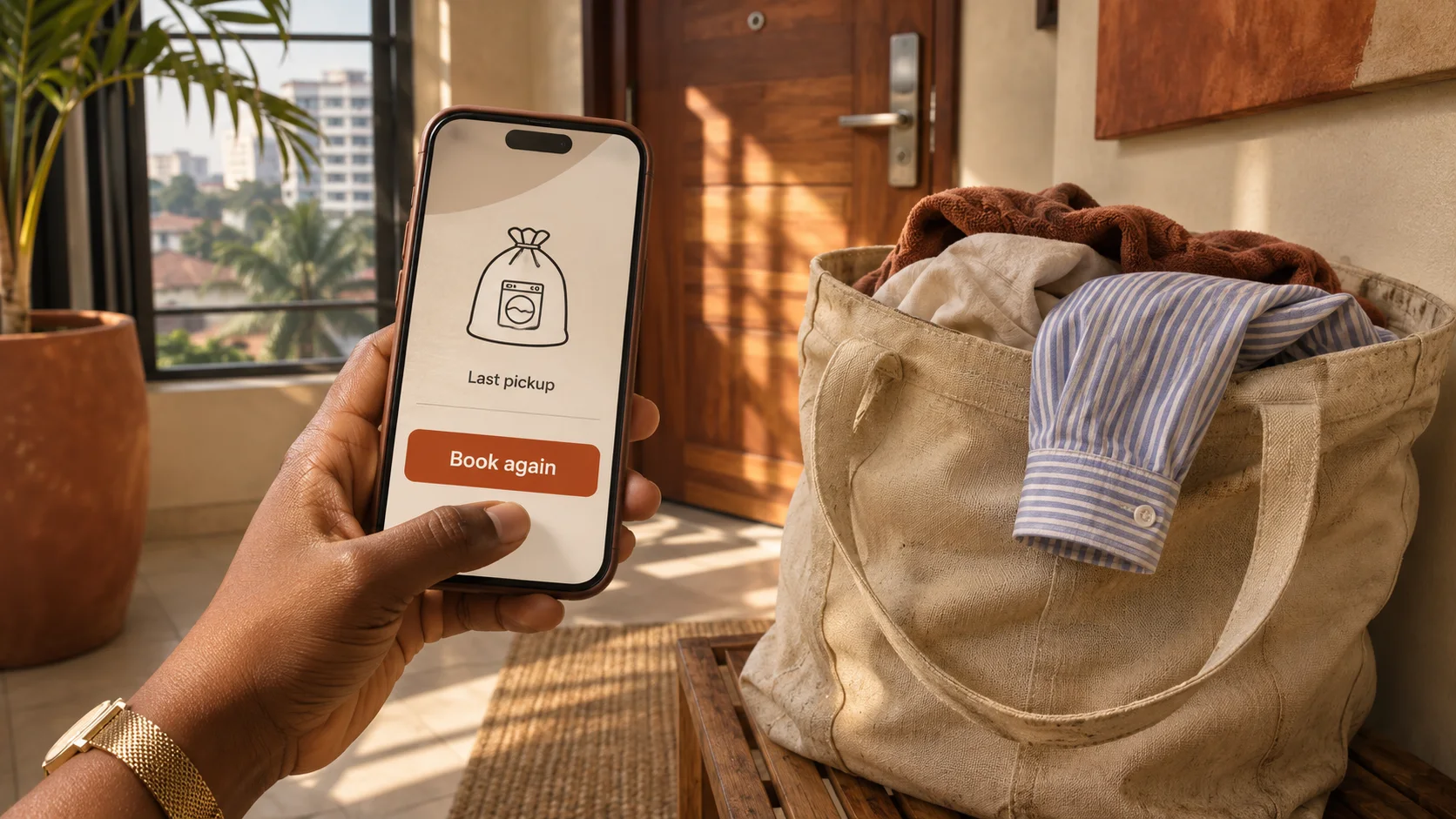
Imagine you run a laundry service. Most orders come through WhatsApp. A customer sends a message, drops a pin, asks how much ironing costs and waits for someone to confirm a pickup. Your team answers the same questions every week. An app seems like an obvious improvement.
You show a few regular customers a design. Their address is saved. Their last order is there. They can book another pickup in two taps. Everyone likes it.
Then laundry day comes around, and one of the people who loved the design sends you the usual message. “Good morning. Can your rider come today?”
That message is worth understanding before you pay to build the app. Perhaps the customer forgot about it. Perhaps WhatsApp was already open. Or perhaps “Can your rider come today?” was never really a booking request. Maybe what they wanted was reassurance that someone could collect the clothes before they left for work.
Those are three different problems. A faster booking screen solves only one of them, and it may not be the one your customer cares about most.
Ask about the last time they needed it
“Would you use an app for this?” is a difficult question to answer honestly, even when someone wants to help. They have to picture a product they have never used and predict how they will behave weeks from now. Saying yes costs them very little.
Try asking a regular customer to walk you through their last order instead. What made them reach for the phone? What did they send? What happened between that first message and the moment they knew everything was sorted?
One person might tell you, “I’m tired of sending my address. You’ve collected from me six times.” Another might say, “I like messaging because I can tell your rider to call me when he reaches the gate.”
Both use the same service. One wants the convenience of a saved address. The other values the freedom to explain something unusual. If your app remembers the address but gives the second customer nowhere to leave a delivery note, your tidier process has made their morning harder.
A handful of conversations like these can give you something specific to test. For the laundry business, the idea might become: Regular customers will book their next pickup themselves if they can choose a collection window they trust and keep their usual instructions. That is a much more useful starting point than “our customers need an app.”
Give them something they can actually use
A clickable design can show you whether someone understands the booking screen. To learn whether they would choose it on laundry day, let them place a real order.
For a few regular customers, a private booking page might be enough. Give each person a way to repeat their usual pickup, change the instructions and choose from two collection windows your team can genuinely honour. Behind the scenes, a member of staff can put the order on the rider’s list. The customer gets clean clothes. You get to see whether the proposed service fits into an ordinary working day.
The part you do manually matters. Having a staff member assign the rider is fine if you are testing whether customers prefer to book for themselves. Having that same staff member message each customer, remind them to book and talk them through every step changes what you are testing.
Keep the customer-facing promise real. Keep the work behind it as simple as you can.
Pay attention to the second opportunity
Suppose a customer tries the booking page on Monday because you personally sent it to them. Their shirts come back on Wednesday. The following Monday, they have another bag ready.
This is the moment the title is asking about. Do they reopen the page, scroll back to find the link, or message your team as usual? If they book online and immediately send “Please, did you see my order?”, count the booking, but pay attention to the message too. They were willing to use the page. They still trusted a person more than the confirmation on the screen.
Look only at customers who actually needed another pickup during the test. Imagine twelve people tried the page, but only five had more laundry ready before the test ended. Three of those five booked through the page again. Saying “only three out of twelve returned” misses the fact that seven people had no reason to return yet. Saying “customers love it” goes further than five repeat opportunities can support.
The useful next conversation is with the two who had another order and chose WhatsApp. Ask, “How did you place your next order, and what made that the easiest way that day?” Their reasons will tell you more about what to change than another round of opinions about the design.
What if customers rarely need the service twice?
Few people book a wedding venue twice. An app for wedding clients might still earn its place if the same couple uses it to approve a floor plan, check a payment date and send a final guest count. The repeat behaviour happens within the booking.
Look for the next occasion in the customer’s life when opening the app would be useful. For a laundry customer, that might be next Monday. For a wedding client, it might be the evening the venue sends a revised seating plan. If the entire relationship consists of one enquiry and one confirmation, a well-designed web page may already do the job. That is a valuable thing to learn before committing to a mobile build.
Decide what the test has earned
Return to the laundry business. If customers book a second pickup on their own and stop messaging to check whether the rider is coming, you have a good reason to invest in that experience. You also have a clearer brief for the first version. The saved instructions and dependable collection windows have earned their place. A loyalty scheme, referral programme and animated order tracker can each wait for a reason of their own.
If customers happily reuse the booking link, there is one more question worth asking. What would installing an app improve for them? The test may have justified a better booking service while leaving the case for a dedicated mobile app open. Equally, customers may keep telling you that they lose the link, miss pickup updates or need one place to manage several orders. Now there is a concrete reason to explore what a mobile app could do better.
Before you commission the build, try finishing this sentence in your customer’s words: “The next time I need to ___, I’ll open this because ___.”
Then give a few customers the chance to do exactly that.